
Criminal Court Cases in Columbia County
The Columbia County Clerk of Court and Comptroller keeps the local criminal case file at 173 NE Hernando Avenue in Lake City. Florida's Circuit Court hears felonies in the Third Judicial Circuit. County Court hears misdemeanors. These names describe jurisdiction, not different public buildings, and both local dockets run through the Clerk. Juvenile delinquency also falls within Circuit Court, but Florida law generally restricts public access to those files.
The State Attorney decides what counts to file. The Clerk then records the information or other charging document, court dates, pleas, motions, rulings, disposition, and sentence. That trail is different from the sheriff's booking record or a police incident report. A booking charge is an initial allegation; a filed count is the prosecutor's accusation; a final disposition is the court's recorded result.
Felony and Misdemeanor Courts in Columbia County
The Clerk's criminal-court service page is the official starting point for felony, misdemeanor, and juvenile jurisdiction. Its layout reinforces a useful local rule: choose the department by the kind of matter, not by guessing which judge or courtroom might have handled an appearance.
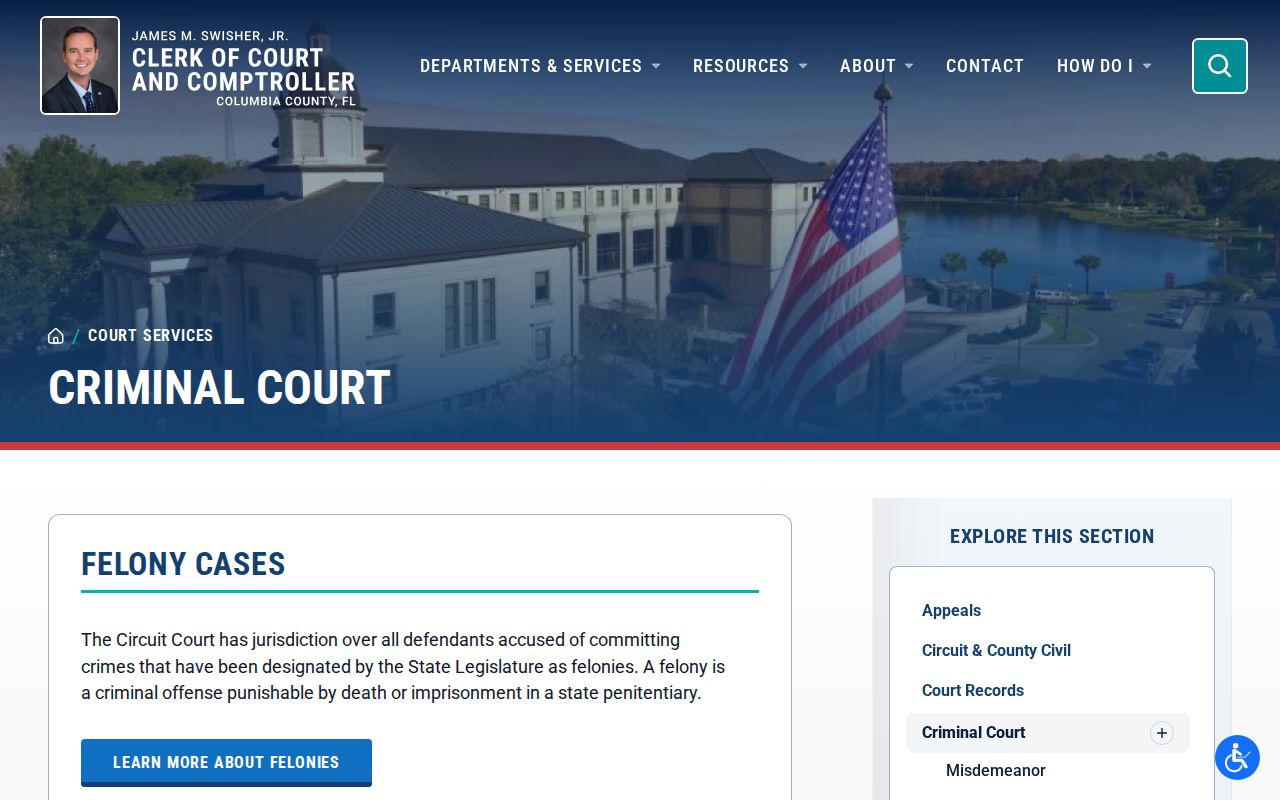
The division label also helps explain a case number and the docket that follows. A felony allegation belongs in Circuit criminal jurisdiction; a misdemeanor belongs in County criminal jurisdiction. Traffic may be civil or criminal depending on the cited offense. Calling a judge's chambers is not the records route. The Clerk's criminal desk is the custodian for inspection, copies, and certification.
Columbia County Case Record Searches
The free online path begins at the Clerk's Court Records gateway. A case number from a citation, bond paper, notice, or jail sheet is usually a stronger key than a name. Confirm that it is a Clerk case number rather than an arrest or incident number. For a name search, gather the middle name or initial, approximate incident date, and likely court level before opening the portal.
- Open the Columbia County Clerk Court Records page and accept its search terms.
- Choose a person search or enter the case number exactly as printed, keeping punctuation and leading zeros when accepted.
- Narrow possible matches with the filing date, case type, charge description, and case number.
- Open the case header and read docket events from oldest to newest, checking each count separately.
- Ask the Clerk for an unavailable image, an inspection copy, or a certified copy, and confirm the current fee before duplication.
| Search field | Best use | Reading caution |
|---|---|---|
| Last and first name | Finding candidate party records | A name alone does not establish identity |
| Case number | Opening one known Clerk file | An agency incident number may not work |
| Case type or division | Separating Circuit and County matters | Juvenile access is restricted |
| Filing date or year | Narrowing a common-name result | Filing may follow the arrest date |
| Case status | Finding open or disposed files | Disposed does not by itself mean convicted |
Accepting Columbia County Clerk Search Terms
The official Columbia County Court Records gateway presents terms before the search. That step matters because the online index is not the certified, official record and should not be the sole basis for legal action. Use it to locate and understand a docket, then obtain the Clerk's authenticated product when formal proof is needed.
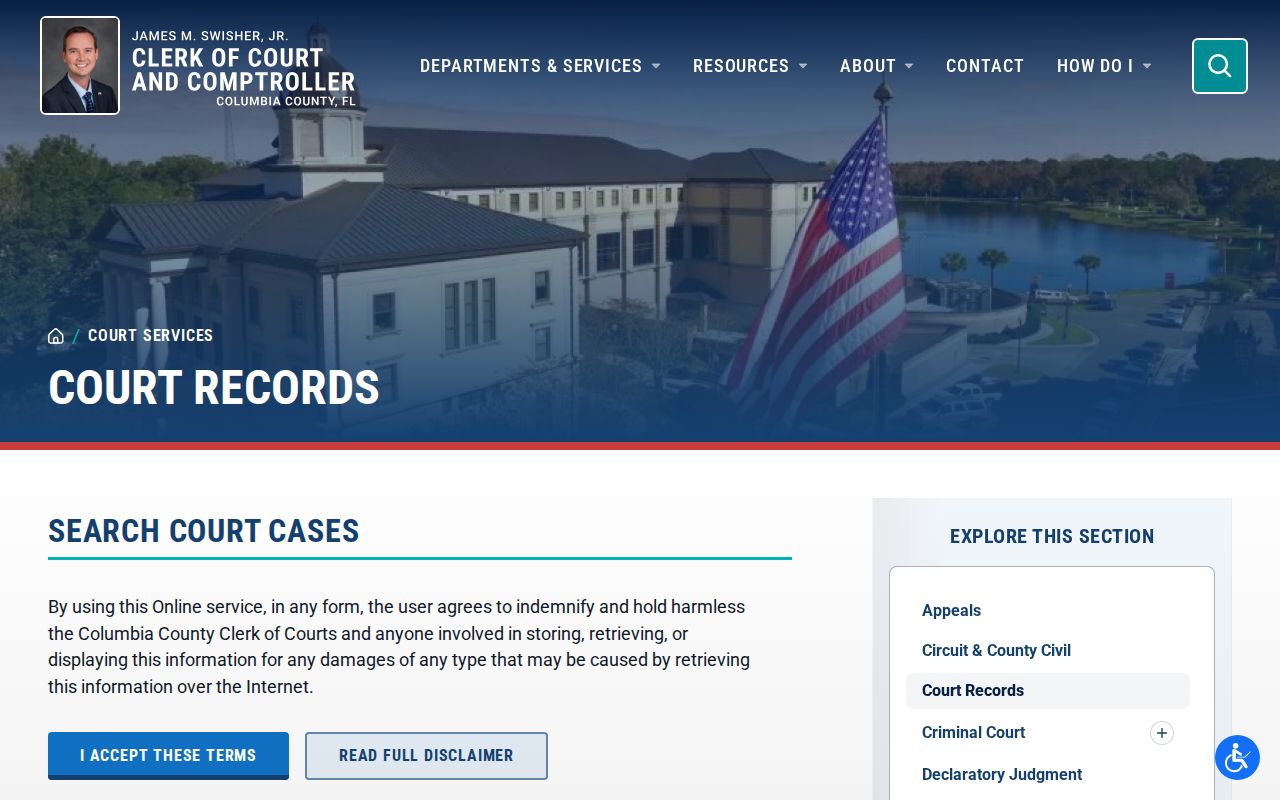
The portal can expose public case headers, events, and some documents. Access depends on Florida's court security matrix and the user's access level. A result should be matched by more than a familiar name. Filing date, count descriptions, case number, and court division offer better confirmation without relying on a single identifier.
What a Columbia County Criminal Case File Contains
A Columbia County case file is an event history, not one fixed summary. Read the header first, then the filed counts, and finally the dated docket. Each count can end differently, so a case with one guilty outcome may also include a dismissed or amended count. A scheduled hearing is not proof it occurred, and a motion records a request rather than a ruling.
| Case number and header | Filing date, Circuit or County division, case type, and open or closed status. |
|---|---|
| Parties and counsel | State of Florida, defendant display, and attorneys when publicly available. |
| Filed charges | Count, description, statute or degree, and count-level disposition. |
| Docket events | Information, arraignment, plea, motions, hearings, judgment, sentence, costs, and public warrant or capias entries. |
| Hearing details | Date, time, event type, courtroom, and judge when scheduled and public. |
| Documents and money | Available images, fines, costs, or balances, subject to access and system display. |
The State Attorney's information is a charging document, not proof of guilt. Likewise, a status marked disposed signals procedural resolution but does not state the result. Open the disposition for each count and note its date before describing the outcome.
Why Columbia County Filings Can Appear Later
The Clerk's search disclaimer says the web information is normally updated around 7:00 a.m. with entries from the prior day. Delay and downtime remain possible. A same-day first appearance, dismissal, new filing, or warrant recall may therefore be missing even when the event has reached court staff.
For time-sensitive facts, contact the Clerk and identify the case precisely. County Criminal can be reached at 386-758-1045 or 386-758-1338, while misdemeanor intake is 386-758-1048. A calendar answers what is scheduled; the filed docket answers what has been recorded. Neither a stale calendar nor an early-morning web result should be treated as the final disposition.
Criminal Case Stages in Columbia County
The court file starts after the prosecutor files a charge, although arrest and first-appearance events may supply earlier docket entries. Counsel appearances and arraignment follow. Pretrial filings can include discovery notices, motions, hearing notices, and orders. The matter may resolve through a plea, trial, dismissal, transfer, or another count-specific result. Judgment, sentence, costs, and later post-judgment activity complete the public sequence when applicable.
Case flow: Charges Filed › Arraignment › Pretrial › Plea or Trial › Disposition › Sentencing
Read the sequence from oldest to newest, but do not assume every scheduled step happened. Check for the later minute, order, judgment, or disposition entry that confirms it. The final judgment is the best local source for the offense and result; the broader Columbia County criminal history overview explains how that outcome may later reach FDLE.
Missing Columbia County Case Images
A docket row without a clickable image does not mean the document is gone. Florida courts distinguish anonymous online access, registered access, parties, attorneys, and courthouse-terminal access. The image may be restricted online, awaiting digitization, or available after staff review. Sealed matters, protected victim details, confidential identifiers, and juvenile material may not be released at all.
The Clerk's department phone directory routes readers to the correct criminal desk rather than chambers. Give staff the full case number, exact docket date, and document title, then say whether inspection, an electronic copy, or certification is needed.
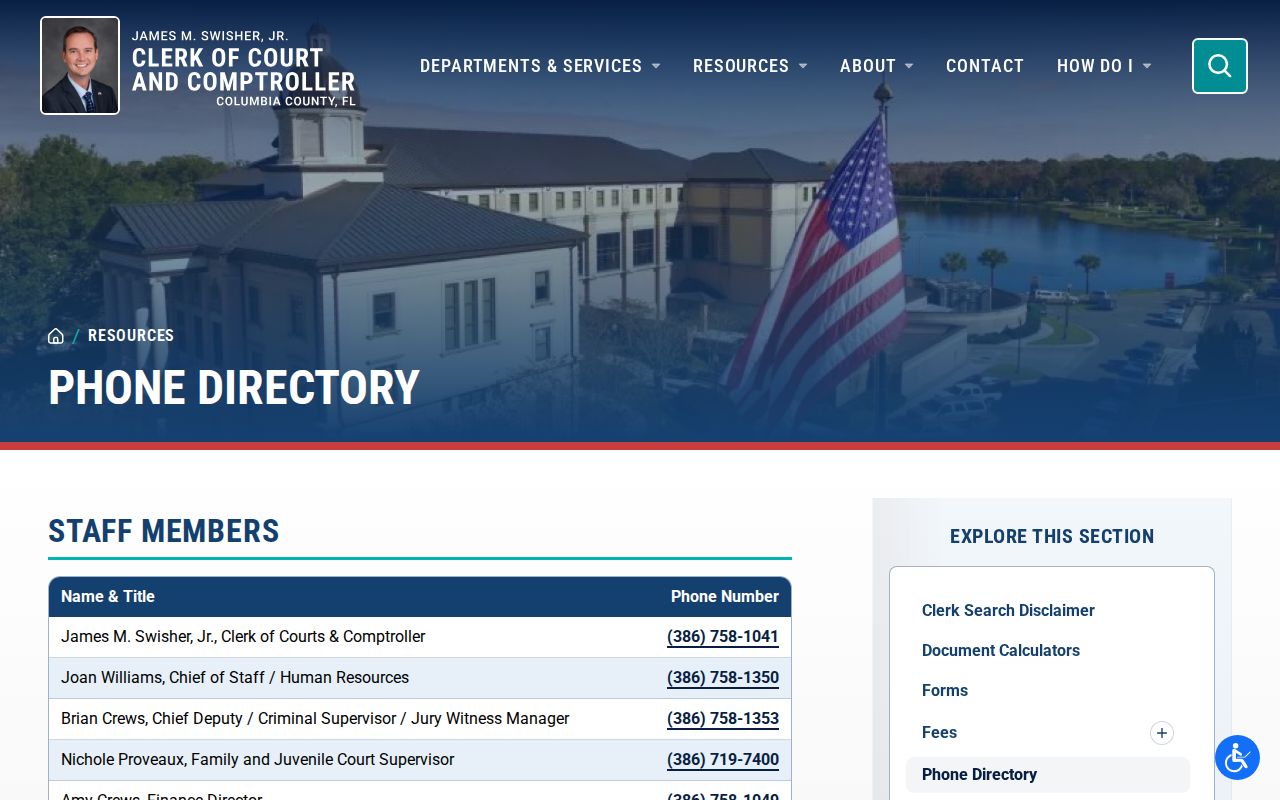
Contact the Clerk for the current copy and certification amount. The reviewed official sources did not provide a current criminal-copy fee, so an Official Records fee or another county's price should not be assumed. Older matters may also be paper-only, archived, indexed differently, sealed, or affected by historical record loss.
Columbia County Appeals and Federal Court Records
Trial, appeal, and federal dockets use different official systems. The Florida Appellate Case Information System covers the Florida Supreme Court and the six District Courts of Appeal. It can follow an appeal from a Third Judicial Circuit matter, but it does not replace the Columbia County Clerk search for the underlying trial case.
Federal prosecutions arising in this area belong to the U.S. District Court for the Northern District of Florida. The official docket route is PACER, not the county portal.
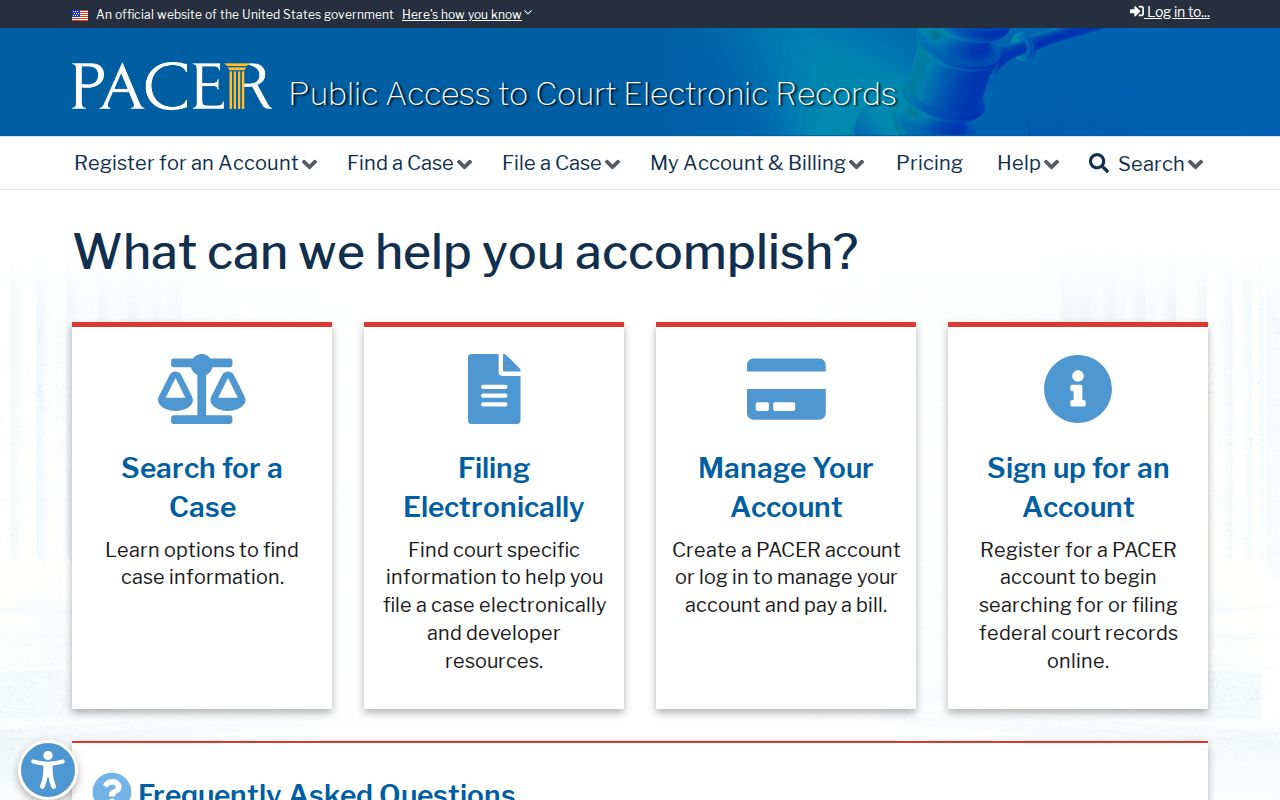
A local event does not become a Columbia County prosecution merely because it occurred inside the county, and a county charge does not appear in PACER unless a separate federal case exists. Start with the court named on the notice, judgment, or case number, then use that court's official search.
Access Rules for Columbia County Case Records
Florida Constitution article I, section 24 favors public access subject to exemptions. Florida Rule of General Practice and Judicial Administration 2.420 specifically governs judicial records. Chapter 119 supplies broader public-record definitions and procedures, while section 119.071 protects categories of law-enforcement, victim, and identifying information. Section 985.04 restricts juvenile records. Court access is therefore more exact than a simple rule that every document must appear online.
The Clerk can release nonexempt portions and identify the authority for a redaction. Sealed and expunged files, protected victim data, confidential identifiers, and most juvenile material may be absent or limited. The internet index may also omit an image that remains available at the courthouse under another access level. Ask about the specific docket item rather than treating a blank link as proof that it never existed.
If an FDLE history lacks a Columbia disposition, locate the Clerk case and obtain the final disposition when appropriate. Then use FDLE's personal-review or challenge process. Repeating a public name search will not itself repair a missing statewide entry, and a Clerk record does not rewrite FDLE data during the reader's session.